Filed under Recipes by Tasha on 27 January 2012 at 3:33 pm
{5 comments}

Carol at Make It, Bake It has set up a new monthly In Season Challenge to make something from an in-season ingredient.
And I have to say, what a brilliant idea! We started trying to cook more with in-season ingredients a few years ago. This was brought on by a need to cut down on our outgoings, however, we soon discovered that fresh, local, in-season produce tastes a lot better than the stuff that’s travelled hundreds of miles on a boat or a plane, artificially chilled and so on.
We don’t manage to cook entirely with local, in-season produce, but we definitely try to use it as much as possible. And it tends to fit with the weather, too. Root vegetables feel better in the autumn and the winter; salads feel better in the spring and summer.
The ingredient for this month is Savoy Cabbage, which is a great vegetable. It has a lovely colour, texture and of course taste. It’s great in soups and stews, but can also be used to wrap other food, as a side dish in itself, as vegetable lasagne and probably a whole bunch of other things, too. Head over to Make It, Bake It on 6 February to read others’ Savoy Cabbage posts.
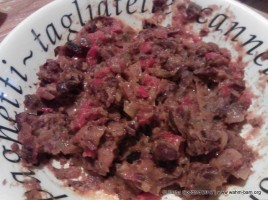
Three Cabbage and Chick Pea Soup

Warming, tasty soup, which can be served puréed or ‘au naturel’. You can vary the cabbage types as you like, but keep the Savoy as the dominant one.
Ingredients
- 2 onions
- 2 tbsp olive oil
- ½ Savoy cabbage
- ¼ Sweetheart cabbage
- ¼ red cabbage
- 1½ litres vegetable stock (I use 4 Kallo stock cubes, rather than recommended 3)
- 1 (400g) tin chick peas
- 2 tsp ground coriander (or handful fresh coriander for a different flavour)
- 2 tsp paprika
Method
- Peel and chop the onions into rough 1-cm cubes.
- Heat the onion in the olive oil until translucent.
- Meanwhile, chop all the cabbage into 1–2-cm chunks.
- Add the cabbage and stir.
- Cook on a low heat for 10 minutes.
- Add the stock and simmer for half an hour.
- Add the chick peas, coriander and paprika and simmer for a further 30 minutes.
- (Optional) Purée the soup.
Serving
Serve with buttery chunks of crusty granary bread. Small bowls as a starter, big bowls as a substantial and nutritious main course.

Filed under Recipes by Tasha on 20 December 2011 at 8:55 am
{10 comments}
The Vegetarian Christmas Dinner post has been getting a huge number of views, particularly from people searching for ‘Vegetarian Christmas Dinner’. One reader, Catherine, requested this recipe from the post, so here it is. I’m happy to post other recipes, if anyone wants them, though I don’t have photos for any of the others!
Vegetarian Christmas Pie
Serves 6–8
This makes an attractive centrepiece, especially when cut into. You can adapt it quite easily for different tastes and diets, too.

Ingredients
- 8 eggs·
- 2 large carrots·
- 1 tbsp honey·
- 2 tsp mustard·
- 2 tbsp water·
- 500g spinach·
- 75g ricotta·
- Salt·
- Pepper·
- Nutmeg (optional)·
- 8 red peppers·
- 50g butter·
- 250g mushrooms·
- 5 gloves garlic·
- 50g butter·
- sweetcorn·
- puff pastry (thawed)·
- 1 egg yolk for brushing (or milk)
Method
- Hard boil the eggs and allow to cool.
- Peel the carrots, then slice them lengthwise into about 0.5cm thick slices.
- Heat them in a pan with the honey mustard and water on a low heat for 10–15 minutes. Set aside.
- Wash the spinach then wilt it in a covered pan.
- Mix the spinach in and season with some salt and pepper and ground nutmeg (if desired).
- Deseed the peppers and cut into thirds (roughly).
- Place skin up on a baking tray and put under a high grill for about 10 minutes.
- Allow to cool slightly, then peel the skin off.
- Melt the butter in a saucepan or frying pan and then heat the peppers for about 5 minutes.
- Chop the mushrooms into slices (about 1cm wide).
- Melt the butter in a frying pan.
- Finely chop (or mince) the garlic and add it to the pan.
- Add the mushrooms and cook on a low to medium heat until they are softened. Set aside.
- Make sure all the vegetables elements and eggs have cooled.
- Roll out the puff pastry – I normally roll out two pieces to make two large sheets that are a bit bigger than my baking sheet.
- Grease the baking sheet and place one puff pastry piece on the baking sheet.
- Layer on the vegetables, leaving 2–3 inches of pastry around the edge. You can layer them in any order you want, really, though its best to put the egg layers in the middle not at the edges.
- Place the other puff pastry sheet on top then join the edges together, fold them over and crimp them (kind of folding at an angle).
- When you’re ready to put it in the oven, brush with egg yolk (or milk).
- Bake in the oven (on a medium to high heat) for around 40 minutes or until the pastry is brown (not burnt!). You can cook the vegetables at the same time.
Adaptations
To make it vegan, leave out the ricotta and egg and brush with soya milk instead of egg or milk. You can change the vegetable layers considerably – go for bright colours for the best effect, but you can also go for strongly contrasting flavours or complementary ones. You could make it into a particularly Christmassy pie, by putting Brussels sprouts and parsnips layers in. You can pretty much change it entirely to your liking – or have a layer to suit all your different tastes – a cheesy pasta layer for the children, a nutty mushroom layer for Granny… and so on…
Accompaniments
Well, it’s Christmas dinner so you’ll be wanting all the trimmings, won’t you? Roast potatoes, roast parsnips, Brussels sprouts, carrots and some lovely gravy (I use 2 tbsp marmite, 1 tbsp tomato puree and one Kallo stock cube with 1 litre boiling water, then thicken up a bit with 2 tsp cornflour and 2 tbsp cold water mixed into the stock). And don’t forget the Christmas crackers! It’s also delicious cold on Boxing Day with a light salad.
Drinking suggestions
Red wine or dark ale. Orange juice and sparkling water. Or the Co-op’s sparkling raspberry juice is also very nice with it.
Filed under Me, Recipes by Tasha on 12 December 2011 at 6:30 am
{20 comments}

One of the first questions people ask me when they find out I’m vegetarian is ‘But what do you eat for Christmas dinner?’ And the answer to that is along the lines of ‘Anything I want to’. To be honest, I think being vegetarian actually opens you up to more adventurous meals – the everyday ones as well as the special ones. It’s quite easy to come up with seven varieties of meat (or maybe fish) and two veg to get you through a week, whereas it’s less so to do the same without the meat (and fish – let’s get something straight right away: if you eat fish, you are not vegetarian). These days, you can probably manage it with a variety of Quorn products or vegetable burgers, but for the most part, if you’re vegetarian you’re still more likely to be preparing and cooking your own food (yes, I know there are plenty of exceptions).
It’s easy, too, to fall into a tradition of what to eat for Christmas dinner – and, actually, that’s not exclusive to meat eaters. So many people seem to have roast turkey (and all the trimmings) or roast chicken (and all the trimmings), with the odd leg of pork thrown in. We always used to have a mushroom and nut wellington. My aunt’s family usually have a sweetcorn, potato and cheese pie. And we all still have these with all the trimmings. Christmas dinner really isn’t the same without roast potatoes, is it?
I try to do something different each year – both for the big meal at our house every other year (where I’m cooking for my folks who are vegetarian) and when I’m up in Scotland with Chris’s family, where I’m the only vegetarian (though it’s always important to make extra, because everyone wants a taste of whatever I do) – oh, and we usually have a second Christmas on New Year for my folks on the years we’re in Scotland. But I do really only ring the changes with the centrepiece. I still do (or share) roast potatoes, Brussels sprouts, carrots and parsnips. Sometimes I have a traditional (but veggie) gravy and sometimes a different sauce, such as cream of red pepper sauce, or cream of asparagus.
Here are some of the centrepieces I’ve made over the years. The majority of them are wellingtons of some kind (that is, something rolled up in puff pastry), though there is an occasional meander of this path.
Mediterranean Wellington
Halloumi surrounded by couscous and wrapped in roasted Mediterranean vegetables (courgette, aubergine, pepper), all wrapped in puff pastry – looks beautiful when sliced (which is one of the main things to look for in a vegetarian centrepiece, in my opinion). (Make it vegan by leaving the haloumi out – you could replace it with some vegan cheese, but I don’t think that would be necessary. Or some tofu might work nicely.)
Nutty mushroom and sausage wellington (vegan)
This one is closer to the one we had when I was little. Large Sosmix (vegetarian sausage mix that you can get from most healthfood shops and a lot of supermarkets) sausage in the middle, either with stuffing inside or wrapping it, wrapped in fried garlic mushrooms and then coated in crushed nuts. Again, the whole thing is wrapped in puff pastry.
Egg and vegetable wellington
This is what I did last year for Christmas Number Two. Different vegetables cooked in different ways and spread on puff pastry in separate layers, include a couple of layers of egg. Vegetable layers can include honey-roasted carrots, spinach and ricotta (or goats cheese), garlic mushroom, olive oil and olives with courgette, sweet peppers and butter… or anything you or your family particularly likes. Bright coloured vegetables make this one look particularly spectacular. (Leave out the egg and swap the butter for marge or olive oil, and you have a vegan version.)
Here’s a recipe for a version of this.
Roulades of courgette and goats cheese and sweet potato and red pepper
Make roulades with pureed vegetables and egg white spread out in a Swiss roll tin and baked for about 20 minutes on a low heat. When they’ve cooled roll them up with a filling – goats cheese and rocket, red pepper and cream cheese, avocado and chilli… whatever you fancy and will go well with the matching roulade. Once prepared I then sprinkle with some parmesan and sesame seeds and reheat for maybe 15-20 minutes. You then serve a thick slice of each to everyone. They look pretty stunning.
Puff pastry pasta cake
Make a cheese pasta – with macaroni or smaller pasta. Roast some vegetables – could be seasonal ones, such as carrot, swede, butternut squash, etc. or Mediterranean, such as courgettes, peppers and aubergine. Put a large circle of puff pastry on a baking tray. Put a layer of the pasta at the bottom in a circle (leave a really good amount around the edges – maybe 10 centimetres), then add the vegetables in layers. Top with the pasta, and then try to spread the pasta around the edges too, so that the vegetables are completely surrounded. Put a smaller circle of puff pastry on the top and then fold up the edges and seal round the edges. Bake for around 35-40 minutes on a medium heat. Serve like slices of cake. (You can do the same but wrap it in roasted aubergine slices, too, rather than puff pastry.)
I’d serve all these with the usual Christmas Day trimmings – roast potatoes and parsnips, with carrots and Brussels sprouts. I’d serve the sausage and egg wellingtons with a traditional gravy (I make mine with a stock of marmite, Kallo veg cubes and a bit of tomato puree and then thicken it with cornflour and water mix). I’d serve the Mediterranean wellington and the roulades with a cream and red pepper (pureed) sauce, and the pasta cake with a tomato and courgette (pureed) sauce.
I should really try to ring the changes a bit with dessert too, though. I’ve served up Delia’s chocolate roulade for the past few years (with a Chantilly and preserve filling, rather than her chocolate mousse). I did make a very nice one many years back, which was individual panetone bread and butter cheesecakes – panetone and butter base, topped with mascarpone and sugar cream and finished off with a berry puree of raspberries and strawberries.
I hope this is of some use to anyone trying to come up with something to cook for a visiting vegetarian, for any vegetarians looking for something new to cook – or maybe even to some meat-eaters who would like an extra centrepiece to accompany the goose or fatted calf.
If you are cooking for vegetarians, take note that a lot of us will not eat roast potatoes and vegetables cooked in the same oven as the turkey (or whatever you’re having). Chris’s parents have a double oven, so when I’m coming to stay the veg gets cooked in the little oven, but before they had their new kitchen I got sauteed potatoes instead (par-boiled then deep fried). You could also roast some in advance and then just give them a quick zap in the microwave.
Whatever you do, do not serve a vegetarian roast potatoes cooked in goose fat – they might be the most delicious thing ever (so I’ve heard, anyway), but they are most certainly not vegetarian. (And while we’re on the tips for cooking for vegetarians, don’t ever use chicken or other meat or fish stock – there are plenty of vegetable stock cubes available, these days (Oxo vegetable stock cubes aren’t very nice, but Kallo are fantastic – just my opinion). A lot of vegetarians also want to have vegetarian cheese (made with vegetable or synthetic rennet, rather than the cow-derived stuff), watch out for jelly which often contains gelatine (try agar agar flakes or there are quite a lot of veggie jelly mixes available these days) and check the ingredients on sauces, sweets and even cakes and any ready meals. If you see the words ‘suitable for vegetarians’ you should be OK, especially on pre-packaged food.
If you’re feeding a vegan, please be extra careful. Honey is not vegan. Eggs and dairy are not vegan. You should also be very careful about cooking utensils and serving dishes (though you should be if you’re feeding vegetarians, too!).
If you’re vegetarian or regularly feed vegetarians for Christmas, I’d love to hear what you have made or are making this year.
And I hope you have a lovely Christmas Meal, whether it’s vegetarian or not.
EDITED TO ADD: This post is getting a lot of visits from people searching for something to cook for vegetarians and vegans for Christmas. I’ve added some notes on a couple of the ideas for how to make them vegan. If you want me to do a separate post of any of the recipes in full, leave a comment, and I’ll try to do so before Monday 19 December, so you have time to plan your shopping.
Filed under Recipes by Tasha on 09 December 2011 at 12:02 pm
{no comments}
I love traditional tortilla, but it is jam-packed full of potatoes and so really quite high GI. So, I thought I’d experiment and see if I could come up with a low GI version. This worked really well (though not as popular with the children as the traditional one).
Ideally, you’ll need a (non-stick) sauté pan (deep frying pan with a lid), but I’ve also used two frying pans of the same size, with one used as a lid with no problems.

Ingredients
2 red onions
1 large courgette
2 tbsp good extra virgin olive oil
2 handfuls of black (pitted) olives
3 handfuls frozen peas
1 block feta cheese (250–300g)
8 eggs
Salt and pepper
Method
Chop the onions into chunks (about 2 cm).
Slice the courgette lengthwise into quarters and then cut into chunks about 1 cm wide.
Put the oil in the sauté pan and heat it up to medium.
Fry the onions and courgettes for 5 minutes.
Chop the feta into cubes (about 2.5 cm).
Chop the olives in half.
Add the frozen peas and continue frying for another 5 minutes (or until you’ve finished mixing the eggs).
Break the eggs into a large mixing bowl.
Add the salt and pepper.
Use a fork to break the yolks up and mix the yolks and whites together, but do so very slowly and gently. Do not whisk like you would an ordinary omelette. The idea is to mix it together without getting any air bubbles into the mixture.
Put the fried vegetables and feta cubes into the egg mixture and mix thoroughly.
Put the whole mixture back in the pan, put the lid on and place on a very, very low heat (if you have a gas cooker with different-sized rings, put it on the smallest ring at the smallest setting). Cook for 30 minutes.
Get a large plate, remove the sauté pan lid, place the plate over the top, take the pan over to the sink and flip it over while over the sink (sometimes some liquid will escape, so it’s safest to do it over the sink). Once the omelette is on the plate, slide it gently back into the pan to cook the other side.
Put back on the very low heat and cook for 15 minutes.
Flip out onto a large plate again, as you did in Step 13.
Adaptations
You could try different vegetable and cheese combinations – asparagus and pecorino go very nicely (I would use a white onion, rather than red onion); sundried tomato, rocket and goats cheese would also work well; you could also try a winter root-vegetable omelette with sweet potatoes, swedes and carrots, with strong cheddar.
Accompaniments
Perfect with a Greek salad or just a nice simple green salad. It’s also lovely with a tomato and bean salad (which would give a great low GI boost, too).
Drinking suggestions
Red or white wine, or grape juice with fizzy water.
Ignore: EUZ7G9YW7UWX
Filed under Me, Recipes by Tasha on 09 September 2011 at 10:30 am
{one comment}
Chris and I are trying to lose weight and get healthier and fitter and, in terms of diet, we’ve found aiming for a low- to medium-GI diet works well for us. We had both lapsed considerably over the summer and are trying to get back on track – both in terms of our diet and exercise. I’ve started running, doing sit-ups and have been sent a Zumba DVD to try out, which I started yesterday (and today everything aches). Chris is jogging with the dog, doing sit-ups, doing a weight-lifting routine and going on long walks.
Chris’s version of the low-GI diet is high in protein and very low in carbohydrates and he has a lot of choice because he can have various meats, fish and seafood. It’s a bit difficult to do high protein when you’re vegetarian, though, especially if you want to keep the high-fat dairy foods to a minimum. Eggs are great, but you can have too many of them. So I am using Rose Elliot’s Low-GI vegetarian Vegetarian Cookbook as a basis, which doesn’t cut out carbohydrates entirely. You can keep the good ones (the slow-release energy ones, essentially) such as oats, wholemeal bread, al dente pasta, buckwheat and quinoa (though bread and pasta should be kept to lower quantities when trying to lose weight).
Beans and pulses are fantastic, because they combine slow-release carbohydrates and protein really well. Having at least one bean- or pulse-based meal a day makes a huge difference to me, reducing my desire for snacks between meals and they also seem to help the weight drop off. I’ve been back on track for only about a week and have already dropped 7lb (still 5lbs to go before I’m back to where I was before the summer slump, though).
The other big thing we’re doing is to have lots of salads. We like to have two or three salads on the go and normally make enough to last for at least two meals, sometimes three (any more and the freshness is completely gone).
Lemon juice and olive oil can reduce the GI of a meal, so if you have your salad dressed with this (vinegar works too), then you can have a bit of medium- or high-GI foods if you want (potatoes are the ones that I want the most).
For snacking, the best savoury thing is salted popcorn. Popcorn seems to have a miraculous weight-loss effect, though I can’t find any documentation to scientifically prove this. Oatcakes are good too, especially spread with lashings of hummus (pulses, olive oil and lemon juice!) The best sweet snacks are fruit, but I’m not very good at just eating a piece of fruit, so I like to have a fruit salad in the fridge to dip into. Chris likes a sliced apple with some Greek yoghurt – or the yoghurt with some breakfast topping mix. Special K is good too and I like to mix mine with some banana and raisins (though they’re not technically low GI). A couple of chunks of dark chocolate are good, too!
After a couple of weeks (I’m not quite there yet) you stop craving high GI stuff (not completely, of course!) and you also want less snacks in between meals. And I find the need to finish the girls’ meals dissipates, too – especially if they’ve got something with a high GI.
I’m not sure what makes us slide away from the low GI diet, though, as we did over the summer, because it honestly feels great when we’re sticking to it – as long as you keep to predominantly low GI meals, you can have the odd baked potato, chips or ice cream. (One great and odd thing is that a low GI meal plays forward – a beany meal with lots of salad at lunchtime means you can cope with a high GI meal at dinnertime, for example.) But I think there’s still that underlying idea that it’s a diet rather than a new healthier way of eating, so you need to reward yourself by stuffing yourself full of the things you’ve denied yourself.
I’m hoping not to slip down that route again.
Have you tried Low GI? What’s your preferred weight loss system? What exercises do you do?
Filed under Domesticity, Me by Tasha on 28 May 2011 at 8:40 pm
{no comments}
It’s National Vegetarian Week this week and I’m guest-posting over at Plus 2.4, so please go and read about how we deal with having a family with one vegetarian, one omnivore and two haven’t-yet-decided children. There are some handy tips about adapting recipes to cater for the different tastes and preferences. And while you’re there read the rest of her Vegetarian Week posts and recipes. There are some yummy sounding recipes up there already and some food for thought too (sorry, hideously obvious play on words there).
In the meantime, here’s my recipe for Vegetarian Lasagne – plenty of dedicated meat-eaters prefer this to a mince lasagne, though I do have to admit that Rosemary’s still not a big fan, which is a shame as it’s one of my favourite dishes.
Vegetarian lasagne
Preparation time: 45 minutes
Cooking time: 40 minutes
Serves: 6-10, depending on how hungry everyone is
Ingredients
For the tomato and vegetable sauce
Olive oil
3 cloves garlic
1 medium onion
2 medium carrots
2 medium peppers (I prefer red and yellow)
1 large courgette
half tube of tomato purée
1 tin of chopped tomatoes (or tin of plum tomatoes, chopped)
herbs to season (I usually use basil, oregano and tarragon)
For the cheese sauce
100g butter
4 tablespoons plain white flour
1 teaspoon mustard powder
1 teaspoon vegetable bouillon powder
250g extra mature cheddar, grated (set aside two handfuls for topping)
milk (probably around .75 litre)
For the topping
2 slices of stale wholemeal bread
a couple of handfuls of the grated cheese from the cheese sauce
Sheets of lasagne
Method
Finely chop the garlic and finely dice the onion and sauté lightly in the olive oil.
Finely dice the carrots and add, stirring.
Finely dice the peppers, stirring.
Finely dice the courgette stirring.
Note: Even if you finely dice it all in advance, do it in that order and leave some time between each ingredient – it doesn’t taste the same if you just shove it all in together.
Allow the vegetables to cook for a few minutes before adding the tomato purée, tomatoes and herbs. Simmer for 20 minutes or so, adding a little water if it gets a bit too dry.
Meanwhile, make the cheese sauce.
Melt the butter in a largish saucepan (non-stick, ideally) on a high heat.
Mix together the flour, mustard powder and bouillon powder.
When the butter is completely melted, add the flour mixture and stir until you have a roue (thick paste).
Gradually pour in some milk, stirring continuously. The sauce will thicken considerably. Keep adding milk and stirring, until the sauce starts thinning out to the consistency you want (thicker than pancake batter, thinner than cake batter).
Take the pan of the heat. Add the grated cheese and stir until it’s melted in.
Note: It’s essential to take the pan off the heat when you add the cheese, otherwise you lose a lot of the flavour.
Preheat the oven to 200°C.
Layer the sauces and lasagne in a lasagne dish – tomato sauce, lasagne, cheese sauce, lasagne, tomato sauce, lasagne, cheese sauce (or just first three, if your dish isn’t deep enough to do two of each layer).
Mix the breadcrumbs and grated cheese together and sprinkle over the top, covering the cheese sauce.
Cook in the oven for 40 minutes.
Accompaniments
Serve with a salad and garlic bread or roast new potatoes and red wine.
Adaptations
We sometimes make two lasagnes – one vegetarian and one meat. We share the cheese sauce and sometimes make a separate tomato sauce which is split in two and to which we add mince or vegetables. If we do it this way, I usually roast the vegetables for 15 minutes, rather than cooking them as above.
You can vary the vegetable content, according to taste and nutritional requirements – e.g. you could add mushrooms, lentils or beans. A layer of fresh spinach (usually requires two whole bags!), blanched for 2-3 minutes, is very nice.
Filed under Domesticity, Recipes by Tasha on 02 December 2010 at 8:58 pm
{no comments}
(or Vegetarian Shepherd’s pie)
This is a lovely one-pot meal (though you can add a light salad on the side, too), especially in winter months, as it’s very warming and filling. Note that this is a pretty salty recipe, so might need adapting/avoiding if you need to keep to low salt.

Ingredients
2 onions
3 carrots
1 courgette
2 handfuls of green beans
punnet of mushrooms
2 tablespoons olive oil
2 handfuls of frozen peas
tin of lentils
2 vegetable stock cubes
2 tablespoons Marmite
1 litre boiling water
3 large (baking size) potatoes
2 medium sweet potatoes
100g butter
salt

Method
Dice all the vegetables finely (around 7mm x 7mm) and sauté them on a low heat in the olive oil – I add them to the pan in the order listed above, stirring and leaving a couple of minutes in between each for the flavours to develop the way I like them to.
Add the peas and lentils.

Make the stock with the vegetable stock cubes, Marmite and boiling water.
Add about half the stock to the pan, turn the heat up to medium/high, put a lid on the pan and let it bubble away. It doesn’t matter if the vegetables stick to the bottom and burn a bit – in fact, that’s actually a desired effect!
Peel and cut up the potatoes and sweet potatoes and boil them until they’re cooked and mashable (stick a fork in and if they crumble a bit, then they’re ready).

Meanwhile, stir the vegetable mixture every 5-10 minutes and add some more stock, bit by bit. You’re aiming for the liquid to be soaked in/burnt off considerably, so that you have a consistency a bit like a bolognese.
When the potatoes are cooked, mash them really well and add the butter and a decent amount of salt (according to taste – though not as much as you might have for plain mash, because the filling is quite salty from the stock and Marmite).
Put all the filling in the bottom of a large (ovenproof) dish – I use either one of the lasagne dishes (as in the picture above) or a large oval dish – and spread it out evenly.
Cover the filling with the mash and spread it out evenly. Use a fork to score patterns in it.
Place under the grill for 10 minutes, or until crispy brown on top.
Accompaniments
Serve on its own or with a light green salad.
A full-bodied red wine or a nice dark ale will go well.
Adaptations
You can go for a slightly lighter version by keeping out the lentils and swapping the potatoes for butternut squash.
Filed under Domesticity, Recipes by Tasha on 26 October 2010 at 10:46 pm
{no comments}

This recipe is generally very popular with children (though it failed on Sunday, probably due to Rosemary and her two friends having far too much fun to sit down and eat food). The magic ingredient is probably the shaped pasta, which we get from our local healthfood shop, Sunshine Health. We’ve so far been unable to find anything resembling it in the supermarkets – if you know of any, do post here. They sell transport pasta, zoo pasta, space pasta (my personal favourite) and teddy bear pasta, and have sometimes also had some Scooby Doo pasta shapes available. Kids love them all. If you have a reluctant eater, having them look for the elephant or astronaut in their food makes a big difference.

Ingredients
3-4 tablespoons good extra virgin olive oil
2 cloves of garlilc
2 onions
3 leeks
3 carrots
2 courgettes
handful of fine green beans
1 large potato
1 tin tomatoes
1 tin beans (haricot or cannellini seem to work best)
1.5 litres stock – we use Kallo Vegetable stock (which also comes in a low-salt version), I put 3 stock cubes and a tube of tomato paste in and then add the hot water
pasta shapes – around 250g, though you can increase or decrease the quantity depending on whether you want it more soupy or more like a pasta and sauce
Method
Chop all the vegetables up small – roughly 5mm cubes. Heat the oil in a very large pan (medium heat). Add the vegetables in the order shown above, stirring and leaving to cook for a few minutes in between each ingredient. When they’re all in (not the tomatoes or beans yet), turn the heat down and simmer for 5-10 minutes before adding the tomatoes, beans and stock. Bring to the boil, then turn down and simmer for about an hour (10-15 minutes will do fine, if you’re in a hurry, but the flavours will be better if left for longer). When you’re about 10 minutes away from serving, add the pasta. (If you want to freeze some, I’d suggest doing it before adding the pasta and adding the pasta for individual portions as and when you defrost them.)
Serve with a nice crusty granary bread spread liberally with butter. Or any bread and butter of your choice. And have fun looking for Saturn!
Filed under Recipes by Tasha on 24 September 2010 at 10:57 pm
{6 comments}
I’ve been collecting together photos of some of our staple meals to start a new recipe series – ones I really like, ones Chris really likes and ones Rosemary really likes (not always the same thing). Eleanor? She’ll eat anything. As will the dog – unless it contains egg or mustard.
The first one was going to be my veggie lasagne, which is one of my absolute favourite meals. Rosemary, though? Not overly keen. The recipe will come soon, but having had such an enthusiastic response when I dished this stew up, I had to change my mind.

Vegetable stew
This is an incredibly simple one-pot meal and perfect for autumn and winter evenings.
2-3 tbsp of very good olive oil (we get a great one from our local market on a Saturday)
1 onion
½ tube of tomato puree
3 vegetable stock cubes (I use Kallo Organic by preference)
1½ litres of boiling water
2-3 carrots
1 medium parsnip
3-4 large potatoes
1 large sweet potato
1 courgette
1 tin of plum tomatoes
1 tin of beans (e.g. haricot or cannelini
Prepare all the vegetables – peel the carrots, potatoes and sweet potatoes and wash the courgette.
Heat the oil (in a large saucepan, casserole or similar) and chop the onion into largish chunks (maybe 3cm x 3cm). Sauté the onion until softened.
Boil the kettle and add the stock cubes and tomato puree to a measuring jug (or a heat-proof bowl or similar).
Meanwhile, chop the carrot into large slices (maybe 2-3cm thick). Add them to the pan and stir – place a lid on the pan.
Chop the parsnip, potatoes and sweet potatoes into similar sized chunks and add them to the pan and stir (replace lid).
Pour the boiling water into the jug (or other container) and stir.
Chop the courgette and add it to the pan and stir.
Add the tin of tomatoes and tin of beans to the pan and stir (replace lid).
Lower the heat to a low medium and let the vegetables cook for 5-10 minutes, stirring occasionally.
Add the stock to the pan and turn the heat down to low. Simmer for anything upwards of 20 minutes – the flavour tends to grow the longer you leave it.
If you can, serve with thick crusty granary bread, spread generously with butter (or Lurpak spreadable, if you can’t be bothered to wait for it to soften). But a seeded batch and Flora Buttery will do. You can also add grated cheddar on top for a slightly different taste (though probably not if you’re dieting!).
You can vary the vegetables as you wish, or according to what’s in season/cheap/in this week’s veg box. For example, we frequently put beetroot in (gives it a beautiful colour – needs to be cooked for a bit longer) and sometimes have swede, butternut squash and others in there.
This usually lasts us two days and, if the children (or you) are bored of it, you can add some pasta in and turn it into a tasty pasta dish instead.
Rosemary’s verdict: “Mmm, mmm, mmm and mmm again”

BLW notes: Take chunks of vegetable out a little earlier and put on a plate to cool. Give them to baby like that and they can explore/eat/throw on the floor as they wish. Dunk some bread in the juices and give to baby. Kallo also do a low salt stock cube, which is useful when the baby’s under a year (or if you need low salt for other reasons).
Dieting notes: You could probably do a low-GI version without the potato. You could leave out the oil and just cook in the stock. Obviously, leave out the lashings of butter and grated cheese!
Filed under Recipes by Tasha on 13 February 2009 at 5:45 pm
{4 comments}
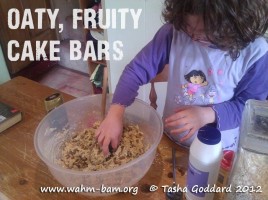
After making Nixdminx’s Grandma’s Cheese Flapjacks a couple of days ago and not eating a single digestive biscuit since then, not to mention having considerably more energy, I thought I would have a go at adapting them to make a sweet version, to satisfy any sweet cravings.
This is what I came up with (my quantities are fairly haphazard as I tend to just throw ingredients in, without measuring):
2 cups of porridge oats
1 grated apple
1 grated (or mashed, if it’s quite ripe) banana
1 cup of dried fruit (I used sultanas, cranberries and goji berries)
Sprinkle of cinammon
1 tablespoon of melted butter
2 eggs
Mix everything together and push into a greased swiss roll tin, spreading as evenly as you can. Bake at 175 C for 25 minutes.
Cut into squares/rectangles/whatever as soon as it’s out of the oven, then leave to cool for half an hour before removing from the tin with a flat spatula or similar.
They were delicious. They were really sweet, without having any added sugar or syrup or anything. They were a bit cake-like, so I might change the quantities a bit next time to make them crunchier. I might also see if they work without the butter – to make them even better for keeping slim!
I loved them. C loved them. R didn’t have a chance to try them, because apparently the dog also loved them and finished the lot when someone (not entirely sure whether it was me or C, so I will assume it was him!) left the kitchen door open and someone (me, unfortunately) didn’t put them away in a tin as soon as they were cooled.
I will be making them again tomorrow.
Thank you Nixdminx for the inspiration – and for the lovely cheesy flapjacks, which are helping considerably in keeping me good.

What you’ve been saying